
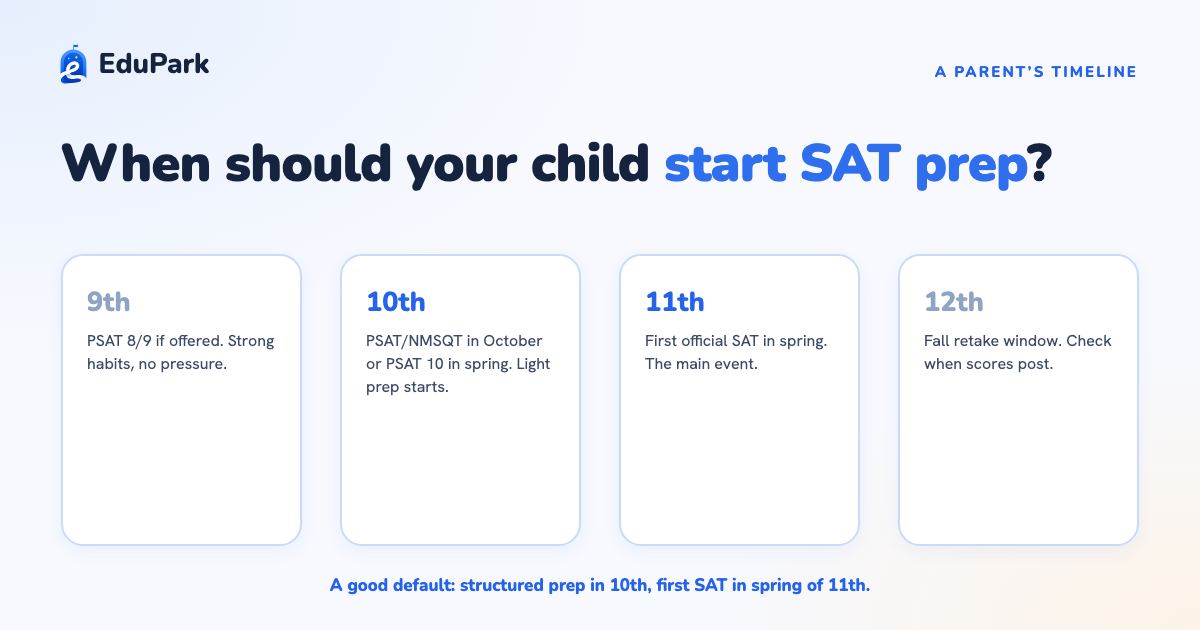
A good default is to start structured SAT prep in 10th grade, with a first official SAT in spring of 11th. College Board recommends taking the SAT in spring of junior year and again in the fall of senior year, but it doesn't say when prep should start, so you can move that either way.
Going early clears the SAT before junior year fills up with harder classes, AP exams, and whatever your child is building outside the classroom. Going later means more of the test is material they have already been taught. Two of the four SAT Math domains, Advanced Math and Geometry & Trigonometry, include material a 10th grader partway through Algebra 2 may not have met yet.
The grade-by-grade SAT prep timeline
| Grade | What to do | Why |
|---|---|---|
| 9th | Take the PSAT 8/9 if the school offers it, in fall or spring; otherwise focus on strong grades in math and English and steady reading habits | Low-stakes exposure to the test format rather than formal prep. College Board calls the PSAT 8/9 a diagnostic test |
| 10th | Take whichever your school offers: the PSAT/NMSQT in October or the PSAT 10 in spring. Start light, foundational review | Same test, different season: they cover identical material, and for a student on the usual four-year track, neither counts for National Merit in 10th grade. College Board calls them benchmark tests, and the score report names skills to work on |
| 11th | Take the PSAT/NMSQT in October, then sit the first official SAT in spring (March, May, or June), with structured prep roughly 8 to 12 weeks out | The primary testing window. For a student on the usual four-year track, junior year is the only year the PSAT/NMSQT counts for National Merit |
| 12th | Fall is the retake window if the spring score fell short. For an Early Action or Early Decision deadline of November 1, October 3 is the last date whose scores arrive in time | In the 2026-27 cycle the August 22, September 12 and October 3 SATs post scores on September 4, September 25 and October 16, all before November 1. The November 7 SAT posts on November 20, after that deadline, though some colleges accept November scores for early rounds |
When should your child take the PSAT?
In October of junior year, if National Merit matters to your family. For a student on the usual four-year track, that's the only PSAT that counts toward it: College Board says National Merit won't consider a PSAT 10 or PSAT 8/9 score. The earlier PSATs are still worth taking. The PSAT 8/9 gives a 9th grader a low-stakes first look at the format, and the 10th-grade PSAT shows which skills to work on before SAT prep starts.
Is it too late to start SAT prep in 11th or 12th grade?
No, but be straight with your child about what changes. Starting in 11th grade still works, with a focused plan:
- Run a full-length diagnostic in the first week. A real timed practice test rather than a study session, so the plan targets the actual weak section instead of guessing.
- Build those weeks around the weak section first. If one section is well behind, give it most of the hours rather than splitting them evenly across Math and Reading & Writing.
- Register for one spring SAT date, then work backward from it. Pick March, May, or June, sign up, and begin structured prep 8 to 12 weeks out. Junior spring is the primary window, so treat that date as the real attempt rather than a trial run.
Starting later costs you room: less time to fix weak areas, and one realistic attempt at a spring test before senior-year applications arrive. What it buys you is coursework, since a junior has seen more of the Advanced Math and trigonometry content than a sophomore has.
Starting in 12th grade leans entirely on the fall test dates, which makes the diagnostic step more important still, because there is no room to spend a whole attempt finding out what is weak. Check the score-release date rather than the test month: for an Early Action or Early Decision deadline of November 1, October 3 is the last SAT whose scores arrive in time, and its registration closed on September 22. Some colleges, including MIT and Dartmouth, accept November scores for early rounds, so check each college's policy.
Start once there's a plan, and a PSAT/NMSQT score (or a full-length diagnostic, if that window has passed) is a good place to build one from. EduPark's adaptive practice meets a student wherever they land on this timeline: a 9th grader building foundations, an 11th grader on the primary track, or a 12th grader working a compressed sprint toward one retake.