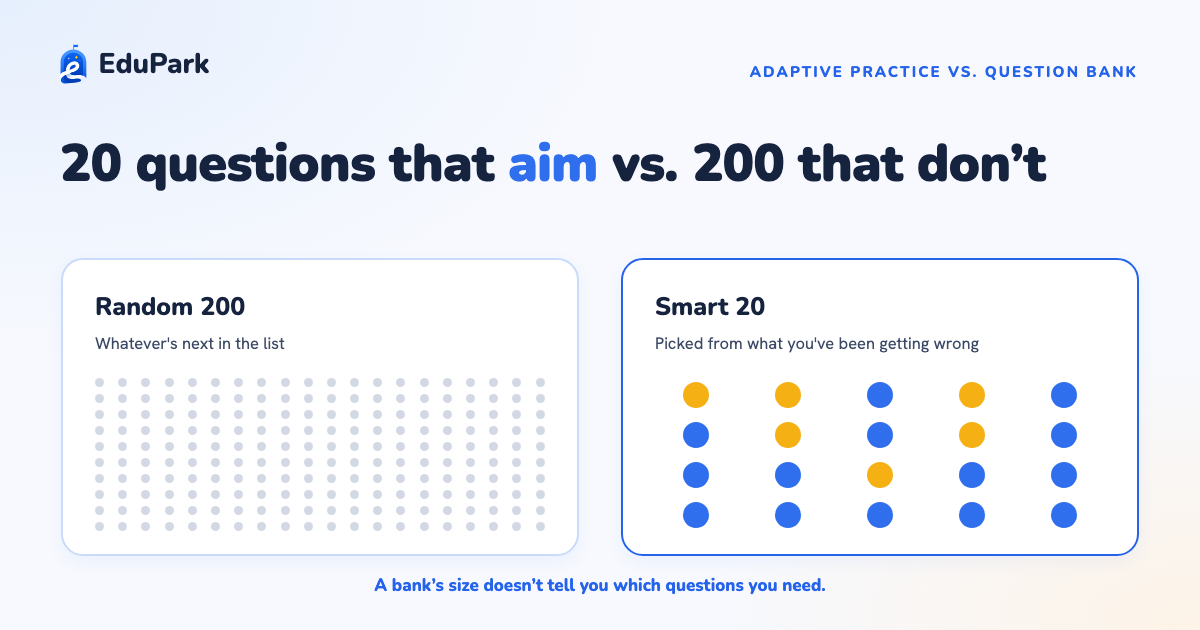
A bigger SAT question bank isn't automatically better prep. Adaptive practice, where your mistakes decide what you practice next, gets more out of each question than grinding a random 200. A random 200 spends a lot of its questions re-testing what you already know; a well-chosen 20 is aimed at the gaps you have. If you're comparing prep options by counting questions, you're comparing the wrong number.
Side by side:
| Random 200 (static bank) | Smart 20 (adaptive) | |
|---|---|---|
| How your next set is picked | It was next in the list | Built from what you've been getting wrong |
| When you miss one | Nothing changes | That topic moves to the front of your practice |
| What an hour buys you | A lot of re-proving what you already know | Questions aimed at your gaps |
The number on a prep site's homepage tells you how much content exists. It tells you nothing about whether any of it is aimed at you.
What grinding a random 200 looks like
Picture a student working through a big static bank, in order or by grinding a topic folder like "Percents." Right answers, wrong answers, doesn't matter: the next question was decided before they ever sat down. Nothing connects question 47 back to what happened on question 12.
Say that student is already solid on simple percent problems (a shirt is 20% off, what's the new price?) but keeps missing the harder kind, where a value goes up 20% and then down 25% and the two changes don't cancel out. A static bank doesn't know the difference. Both kinds sit in the same folder, so it keeps serving the easy version they've already mastered right alongside the one that's costing them points. Real hours go in. Only some of them count.
What the smart 20 looks like instead
Now give the same student an app that pays attention. It has seen their past answers, so it knows percent problems are costing them points. It keeps giving them practice there, at a difficulty set by how they're doing, instead of the easy repeats they've already mastered. Try it:
The value of a certain stock increased by
Show step-by-step walkthrough
-
Read & Translate
We need to find the overall multiplier
that relates the stock's 2023 value to its 2021 value. The stock goes through two consecutive percentage changes: a 20% increase (2021→2022), then a 25% decrease (2022→2023). A common trap is thinking these cancel out — they don't, because each percentage is applied to a different base value. Consecutive percentage changes — When percentages are applied sequentially, each change acts on the result of the previous one, not the original value.
-
Apply First Change
A 20% increase means we multiply by
. This gives the stock's value at the beginning of 2022 in terms of its 2021 value. -
Apply Second Change
A 25% decrease means we multiply by
. Crucially, this decrease is applied to the 2022 value, not the original 2021 value. Since the 2022 value is larger (after the 20% increase), the 25% decrease removes a bigger chunk than the 20% increase added. -
Find Overall Multiplier
Now substitute
into the equation from the previous step. The two multipliers combine into a single overall multiplier — that's our . -
Verify & Match
The problem tells us
. Comparing with our result, . This makes sense: the stock ended up worth 90% of its original value — a net 10% loss. The decrease "won" because 25% of a larger number is more than 20% of the original. This matches Choice A. Consecutive percentage changes — Consecutive percentage changes
Why this answer is right
A
Applying a 20% increase gives a multiplier of 1.20, then a 25% decrease gives a multiplier of 0.75. The overall multiplier is
For consecutive percentage changes, multiply the individual multipliers — never add or subtract the percentages directly.
Why the other choices are traps
-
D
This answer (1.05) comes from treating the percentages additively and then reading the net change with the wrong sign: computing 25% − 20% = 5% and taking it as a 5% net increase gives 1 + 0.05 = 1.05. It is the mirror image of choice B (0.95), which nets the same 5% difference as a decrease. Both are wrong because consecutive percentage changes multiply rather than add — the correct overall multiplier is
. Treating consecutive percentage changes as additive — and here also misjudging which change dominates — instead of multiplying the
and multipliers. -
C
This answer (1.00) comes from assuming the percentage changes cancel out: +20% then −25% should leave the stock unchanged, because the percentages feel roughly similar. But
, not 1.00. A 25% decrease of a larger number removes more than the 20% increase added. The intuition that 'an increase then a similar decrease returns to the original' is wrong because each percentage acts on a different base.
-
B
This answer (0.95) comes from simply subtracting the percentages:
, so the multiplier would be . This treats the percentages as additive, but percentage changes are multiplicative. The correct calculation is , not . Subtracting percentages directly is the most common error on consecutive percentage change problems.
Expert tips
For consecutive percentage changes, always multiply the multipliers:
. An increase of followed by a decrease of gives a net multiplier of . This is faster than tracking actual dollar amounts and works for any starting value. Quick mental math:
. Converting 0.75 to the fraction makes the multiplication instant — no long arithmetic needed. Think of it this way: if a stock goes up 20% then down 20%, you always lose money (the multiplier is
). The bigger the percentage swing, the bigger the loss. Here the decrease is even larger (25% vs 20%), so the loss is greater — confirming the answer must be below 1.00.
Whichever way that went, something just changed
- Got it right? That counts toward your mastery of the topic, so it takes up less of your practice from here, with no wasted repeats.
- Got it wrong? This topic moves to the front of your next practice session, ahead of the things you've already proven rather than buried in a folder you might not open for weeks.
Either answer teaches the app something and changes what comes next. A static bank would have handed you the same next question either way.
What to compare instead
If you came here from a "best SAT question bank" list, the tiebreaker is one question: does anything change based on what you just did? A large static bank can leave a real gap untouched for weeks. Twenty questions picked from what you've been missing go straight at it.
On EduPark, that one idea runs through everything: what you get wrong shapes your next practice session and what's waiting at the top of your dashboard tomorrow.
Volume is easy to advertise. Ask what happens after each question instead.
Practice with free SAT questions that adjust to how you answer.
Start free