
EduPark is an AI-powered SAT prep platform built to help students get their highest score possible in the least amount of time needed.
The product works as a loop: each practice session shapes the next one.
How every answer shapes what's next
1. Practice. You work through problems and mock exams, and EduPark records every answer: whether you got it right, which topic it tested, and how long it took you.
2. Signals. Each answer updates a mastery score for that topic, based on your recent answers and how hard those questions were. Together those scores make a topic-by-topic map of where you stand: which topics are solid and which are shaky.
3. Feedback. When a session ends, EduPark uses that map to rebuild your recommendations and your next practice session. Weak topics that count most on the test come first, and each topic's difficulty is set by how you're doing on it.
Side by side with a static question bank:
| A question bank | EduPark | |
|---|---|---|
| You miss a question | Nothing changes in what comes next | That concept comes back in later sessions until it's solid |
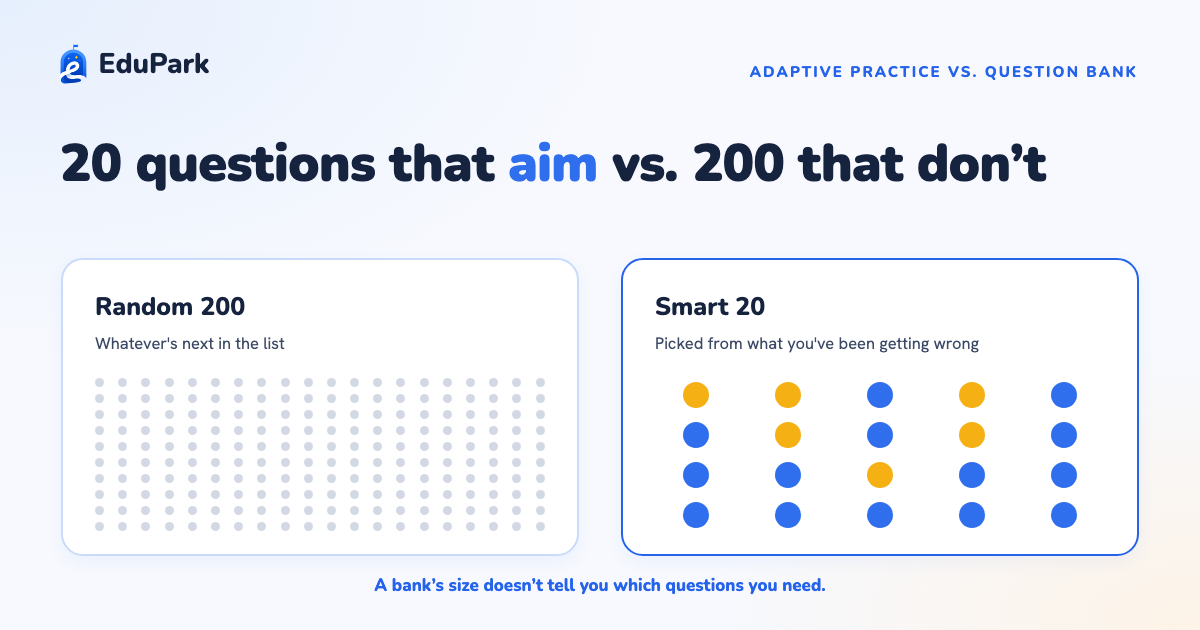
| What you practice next | Whatever's next in the list | The topics most likely to move your score |
| Your progress | A percent-correct number | A topic-by-topic mastery map that updates as you go |
More questions isn't the goal. The right next question is. We go further into that in 20 targeted questions vs. 200 random ones and how adaptive SAT practice works.
Try it: this is the loop's raw material
Everything above starts with a question like the one below. Try it, then open the full explanation. An answer like this one is what shapes your next practice session.
Which of the following systems of linear equations has no solution?
Show step-by-step walkthrough
-
Identify the Goal
We need to find which system of linear equations has no solution. A system has no solution when the two lines are parallel — meaning they have the same slope but different y-intercepts. All four options are already in slope-intercept form (
), so we can read the slope and y-intercept directly. Parallel lines and no solution — Parallel lines never intersect, so there is no point (x, y) that satisfies both equations simultaneously.
-
Compare Slopes & Intercepts
Let's extract the slope and y-intercept from each system. We're looking for the pair where slopes match but y-intercepts differ. Options with different slopes will intersect (one solution), and options with both matching represent the same line (infinitely many solutions).
-
Confirm No Solution
Option C has
(parallel lines) but (different intercepts), so the lines never intersect. Setting the equations equal confirms there's no valid . The answer is Choice C. Systems with no solution, exactly one solution, or infinite solutions — Systems with no solution, exactly one solution, or infinite solutions
Why this answer is right
C
The system
For no solution, look for same slope + different intercept — parallel lines that never meet.
Why the other choices are traps
-
B
This system has the same slope (
) AND the same y-intercept ( ). Since both equations are identical ( ), they represent the same line, giving infinitely many solutions — not zero. Students who pick this confuse "same slope" with "no solution," forgetting that the intercepts must also differ. Seeing identical equations and thinking 'same equation = no new information = no solution' instead of recognizing that every point on the shared line is a solution.
-
D
This system has different slopes (
vs ). Lines with different slopes always intersect at exactly one point. Setting gives , — a valid solution exists. Students who pick this may focus on the matching y-intercept ( ) and mistakenly think matching intercepts cause no solution. Confusing 'same y-intercept' with 'same line' or 'no solution,' when it's the slope that determines whether lines are parallel.
-
A
This system has slopes
and . Although and look related, they are different slopes, so the lines intersect. Setting gives , so , — one solution. Students may think opposite slopes mean the lines "cancel out" and produce no solution. Thinking opposite-sign slopes (2 and −2) are 'the same' or that they somehow cancel, when in fact they produce lines that cross in a V or X shape.
Expert tips
For systems in slope-intercept form, the solution count depends entirely on two comparisons: slopes equal? Intercepts equal? Same slope + different intercept = no solution. Same both = infinite. Different slopes = exactly one. Memorize this 3-case framework.
When all options are already in
form, skip solving — just compare the and values visually. This problem can be answered in under 15 seconds by scanning the four pairs of slopes and intercepts. If you find a contradiction like
when setting two equations equal, that's a definitive confirmation of no solution. This algebraic check is a reliable way to verify your slope-comparison reasoning.
Nice work trying this one. Want the full step-by-step walkthrough — and practice picked for you? Try EduPark free.
Try EduPark freeWhat you'll use
Here's what that looks like in the product:
- Full adaptive mock exams. Same format as test day: two sections split into four modules, 98 questions, and a second module that adapts to how you did on the first. The built-in graphing calculator and reference sheet are there too. Each mock is assembled fresh from the question bank, at one of four difficulty levels.
- Tutor Mode. Animated, step-by-step walkthroughs with passage highlights, answer eliminations, and a breakdown of why each wrong answer was designed to trap you, built for that exact question. (How is that different from just asking ChatGPT?)
- Structured lessons. 100+ lessons across SAT Math and Reading & Writing, with video and practice built in.
- A vocabulary builder that schedules itself. Spaced-repetition flashcards and four quiz modes, so a word you miss comes back sooner and one you know comes back later.
- Desmos mastery guides. Scenario-based training for the Desmos graphing calculator built into the digital SAT.
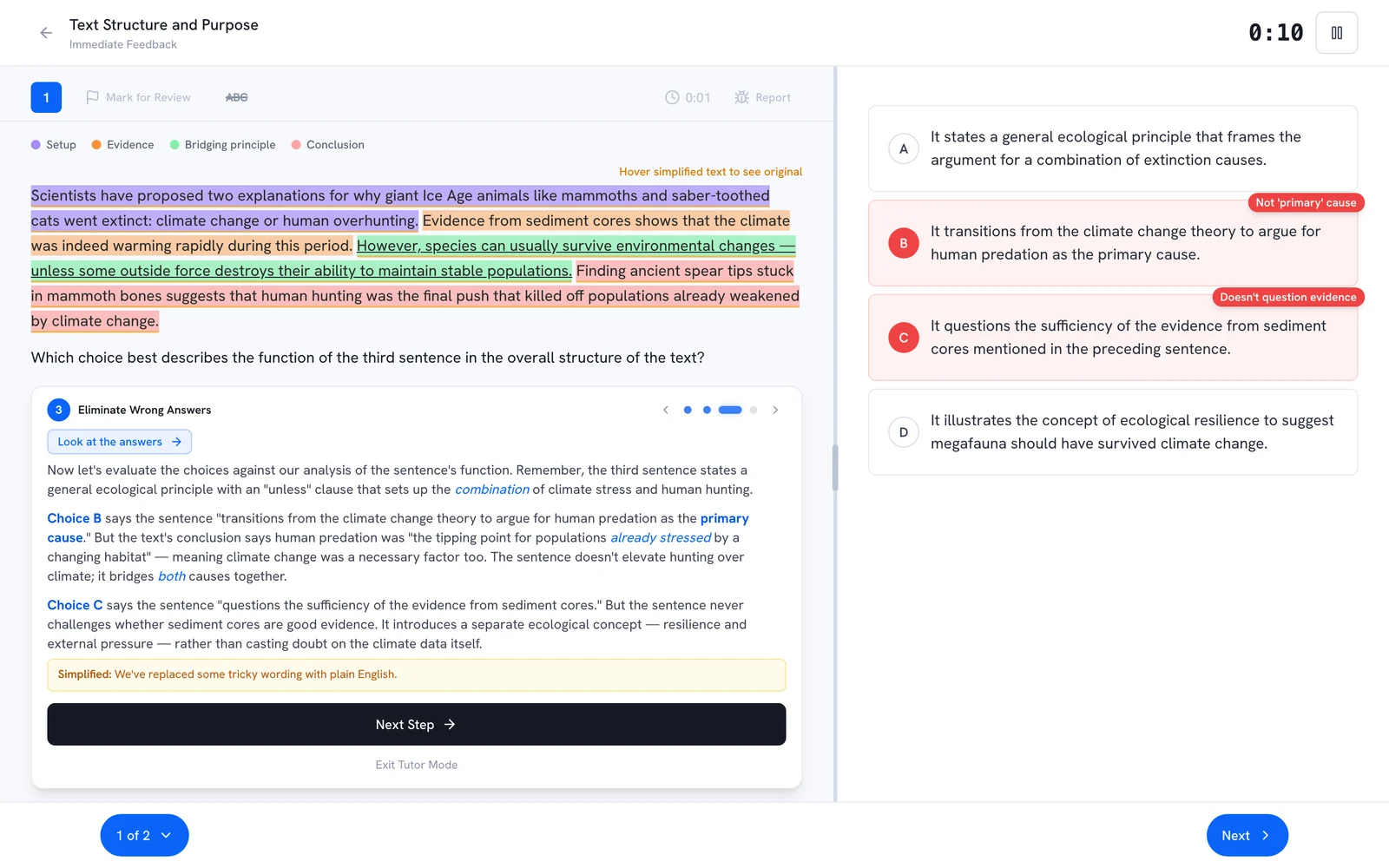
Here's an evidence-reasoning question to try. Tutor Mode explains why the answer is right, and it also teaches the reasoning behind it, so you know how to solve the next question built the same way.
A researcher proposes that students who handwrite lecture notes remember the material better than students who type notes because handwriting is slower, forcing students to summarize ideas in their own words rather than copy them down verbatim.
Which finding, if true, would most directly weaken the researcher’s explanation?
Show step-by-step walkthrough
-
Pin the Task
This question asks which finding would most directly weaken the researcher’s explanation. Note the target: not the fact that handwriting helps memory, but the reason the researcher gives for it. Weaken the explanation, not the result.
-
Break Down the Claim
The researcher’s explanation is a mechanism: handwriting is slower, which forces students to summarize ideas in their own words — rather than copy them down verbatim. That summarizing, the researcher says, is why handwriters remember better. A finding weakens this explanation if it shows the memory benefit appears even without the summarizing.
-
Eliminate the Off-Target Choices
Set aside two choices that leave the mechanism untouched. That most students preferred typing reports a preference and says nothing about why handwriting aided memory. That handwriters wrote roughly half as many words per minute merely confirms handwriting is slower — a premise of the explanation, which strengthens rather than weakens it. Neither breaks the Summarizing link.
-
Test the Tempting Choice
The trickiest choice reports that handwritten notes contained many more paraphrased summaries than typed notes. It is right on the mechanism’s topic — summarizing — so it feels central. But paraphrasing more is exactly what the researcher’s Summarizing mechanism predicts, so this finding supports the explanation. On a weaken question, confirming the mechanism is the wrong direction.
-
Confirm the Answer
Choice C weakens the explanation most directly: students who handwrote their notes word for word, copying the lecturer almost verbatim, still remembered the material better than students who typed.
If the memory advantage survives even when handwriters do not summarize but copy verbatim, then summarizing cannot be the reason handwriting helps — which is precisely the mechanism the researcher proposed. The benefit appears with the Summarizing step removed.
The rule: to weaken an explanation, sever its proposed mechanism while the effect persists. Findings that confirm the mechanism (more paraphrasing) or a premise (handwriting is slower) push the other way and strengthen it.
Textual Evidence Support — To weaken the explanation, break the proposed mechanism — show the memory benefit survives even without the summarizing the researcher credits.
Why this answer is right
C
Choice C shows the memory advantage persists even when handwriters copy verbatim instead of summarizing, which undercuts the researcher’s explanation that summarizing is why handwriting helps.
Weaken an explanation by keeping the effect but removing its proposed mechanism; confirming the mechanism strengthens it.
Why the other choices are traps
-
A
More paraphrasing in handwritten notes is exactly what the researcher’s summarizing mechanism predicts, so it strengthens rather than weakens the explanation.
Because it is on the mechanism’s topic, students assume it must be the answer without checking that it confirms rather than undercuts.
-
B
Students’ preferences say nothing about why handwriting produced better memory, so the finding neither supports nor weakens the explanation.
A fact about how students feel gets mistaken for evidence about the cause of the memory benefit.
-
D
Confirming that handwriting is slower supports a premise of the researcher’s explanation rather than weakening it; the stem asks for a finding that weakens it.
The slowness is part of the researcher’s own reasoning, so restating it feels relevant while actually reinforcing the claim.
Expert tips
An explanation says "effect happens because of mechanism." To weaken it, find evidence that the effect still happens with the mechanism absent.
Weaken questions bait you with mechanism-confirming choices. If a choice makes the researcher’s reasoning look better, it is the wrong answer here.
Nice work trying this one. Want the full step-by-step walkthrough — and practice picked for you? Try EduPark free.
Try EduPark freeWho EduPark is for
EduPark serves two customers on one platform, with the same engine underneath.
For students and families, the loop is a personal coach: you know what to study next, and why.
For tutoring centers and schools, the same signals become oversight. Build classes and assign five kinds of work: mock exams, section exams, smart practice, lessons, and vocabulary quizzes. Watch class analytics, with at-risk alerts that name why each student was flagged. And share progress reports parents can open from a single link, no login needed, branded with your program.
The content, the engine and the signals are the same in both cases. A student sees what to practice next, and an educator sees who needs help and how the class is progressing.
What's live today, and what's next
SAT is live today, and everything above is running now. More exams are on the way, including the SHSAT, PSAT, PreACT, AP, IELTS and TOEFL.
The short version
EduPark turns what you do, every problem and mock exam, into what you should do next. Students get a coach, and educators get a clear view of who needs help. You can try it free, with no credit card: the free plan includes a full-length mock exam and a set of practice questions.