Is an AI SAT tutor just a ChatGPT wrapper? No, but not because ChatGPT forgets you between sessions. It has been able to reference your past chats since April 2025 on paid plans, and since June 2025 on free accounts.
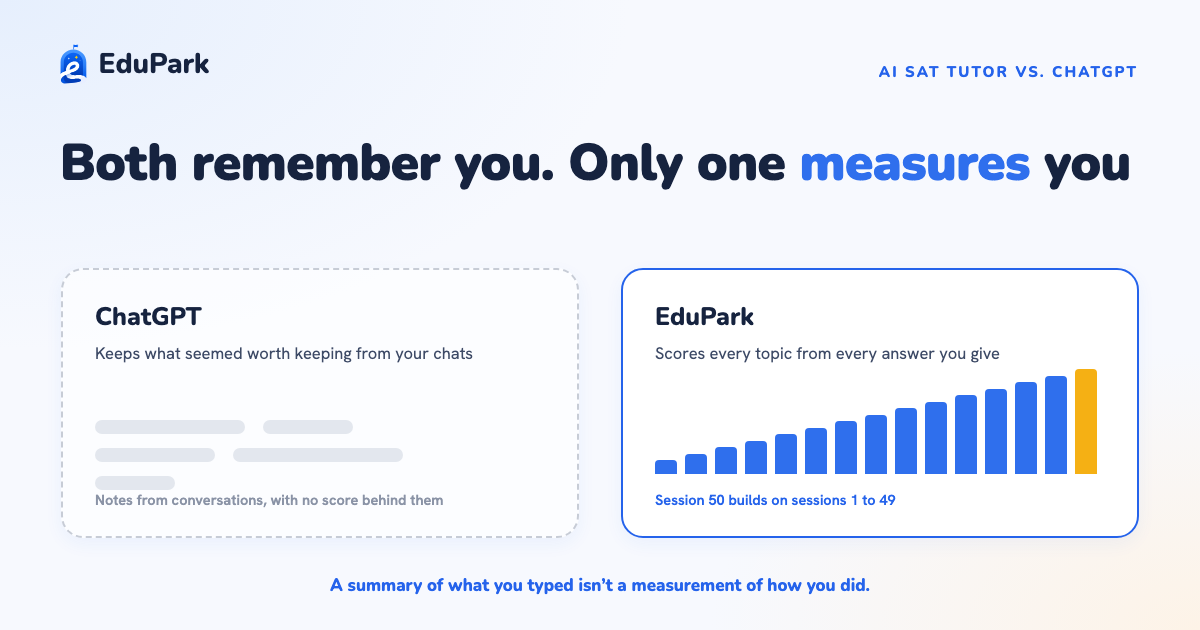
The two differ in what the record is made of. EduPark keeps a mastery score for every topic, recomputes it on every answer you give to a verified SAT question, and uses it to pick what goes into your next practice session. That is a measurement of your performance, rather than a summary of things you happened to type.
What ChatGPT is good at
ChatGPT is strong at explaining a concept on demand, rephrasing something confusing in a different way, or walking through a single problem step by step if you paste it in. If you're stuck on a question and just need someone, or something, to explain why the answer is B, it does that well.
Where it runs out is measurement. Its memory keeps what looks worth keeping from your conversations, which is a different thing from a per-topic score computed from every answer you have given. On its own, it has no bank of verified, exam-accurate SAT questions, so you either paste questions in or practice on ones it writes on the spot. Its study mode will quiz you at your level, but nothing turns those answers into a per-topic score that picks your next practice.
None of that makes ChatGPT bad. It makes it a tool for a single moment rather than a system for weeks of prep. Side by side:
| ChatGPT | A dedicated AI SAT tutor | |
|---|---|---|
| Explaining one problem, right now | Good | Good |
| What it keeps about you | Whatever looked worth keeping from your chats | A score per topic, recomputed on every answer |
| Verified, exam-accurate question bank | No: you paste questions in, or it writes them on the spot | Built in |
| Deciding what you practice next | Study mode quizzes you at your level, with no per-topic record behind it | Ranked for you from your actual record |
What "personalized" means here
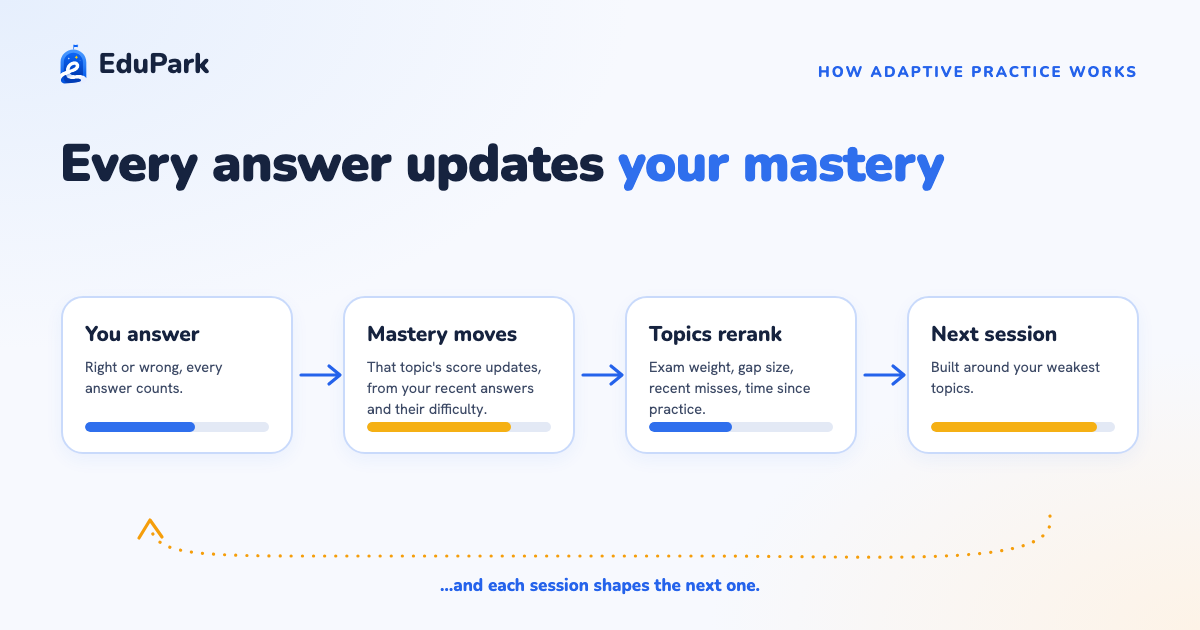
Every question you answer on EduPark updates a mastery score for that specific topic. The score is built from your recent answers on that topic and how hard those questions were, and older answers drop out as new ones come in. A bad stretch on a topic shows up quickly; so does an improving one. That score feeds what gets recommended next, alongside how often the topic shows up on the real SAT and how long it's been since you practiced it.
A general assistant isn't keeping that record. Its explanations may be just as good as ours; what it doesn't do is turn weeks of your own answers into a score that decides where you go next.
A concrete example
Say you keep missing questions on percent-change and compounding, the "a stock's value goes up 20%, then down 25%, what's the net multiplier?" kind of question. Each miss nudges that topic's mastery score down. Because the score responds to recent performance, the platform doesn't need dozens of repeats to notice the pattern. A string of missed answers on that topic is enough to register it as somewhere you are struggling now rather than somewhere you struggled months ago.
That topic then rises toward the top of your next recommended practice, at a difficulty that matches where you are on it. Here's the kind of question that pattern is built from:
A bookstore buys a shipment of novels at a wholesale cost of
Show step-by-step walkthrough
-
Identify Given Info
We need to find the bookstore's profit on each novel sold at the sale price. We're given three key pieces: the wholesale cost is
, the retail price is a markup on wholesale, and the sale is off retail. Profit = Sale Price − Wholesale Cost, so we need to work through two percentage calculations first. -
Calculate Retail Price
The retail price is set by increasing the wholesale cost by
. An increase of means we multiply by (that's ). This gives us the price before any sale discount. -
Apply the Discount
Now we apply the
markdown to the retail price. A discount means the customer pays of the retail price, so we multiply by . Be careful — the discount is off the retail price (300), not the wholesale cost. -
Calculate Profit
Profit is the difference between what the bookstore sells the novel for (the sale price) and what it originally paid (the wholesale cost). Subtract the wholesale cost from the sale price to get the answer. This matches Choice A (40).
Successive percentage change (markup and discount) — Successive percentage change: apply the markup to the wholesale cost, then apply the discount to the resulting retail price, and subtract the cost from the sale price to get profit. Each percentage acts on its own base, so the two changes cannot be merged by adding or subtracting the percentages.
Why this answer is right
A
The retail price is
Apply each percentage change sequentially to its correct base — the markup applies to wholesale, and the discount applies to the marked-up retail price.
Why the other choices are traps
-
B
This comes from naively combining the percentages:
, then computing of . This is wrong because the discount applies to (the retail price), not to (the wholesale cost). The two percentages have different bases and cannot be simply subtracted. Students often assume successive percentage changes can be combined by adding or subtracting the percentages, but each percentage applies to a different base amount.
-
D
This is the sale price itself (
), not the profit. A student who correctly computes the sale price but forgets the final step — subtracting the wholesale cost — would choose this answer. Confusing the selling price with the profit. Profit requires subtracting the original cost from the revenue.
-
C
This is the markup amount alone:
of . A student who calculates the retail markup but forgets to apply the sale discount would arrive at this answer, treating the full retail price as the selling price. Ignoring the discount step entirely and assuming the novel sells at the full retail price.
Expert tips
Chain multipliers in one step:
. This combined multiplier of shows the net effect is a increase over wholesale, making the profit obvious. Whenever you see successive percentage changes, remember: a
increase followed by a decrease is NOT a increase. Multiply the multipliers ( ) to find the true net change. After finding the sale price, always re-read the question — it asks for profit, not the sale price. Many SAT percent problems include intermediate values as trap answers, so double-check you're answering exactly what's asked.
And when a question does need explaining, it isn't a wall of chat text either. Problems carry a purpose-built, step-by-step walkthrough, with the key evidence highlighted and each trap answer broken down. Here's one partway through a Reading & Writing question:
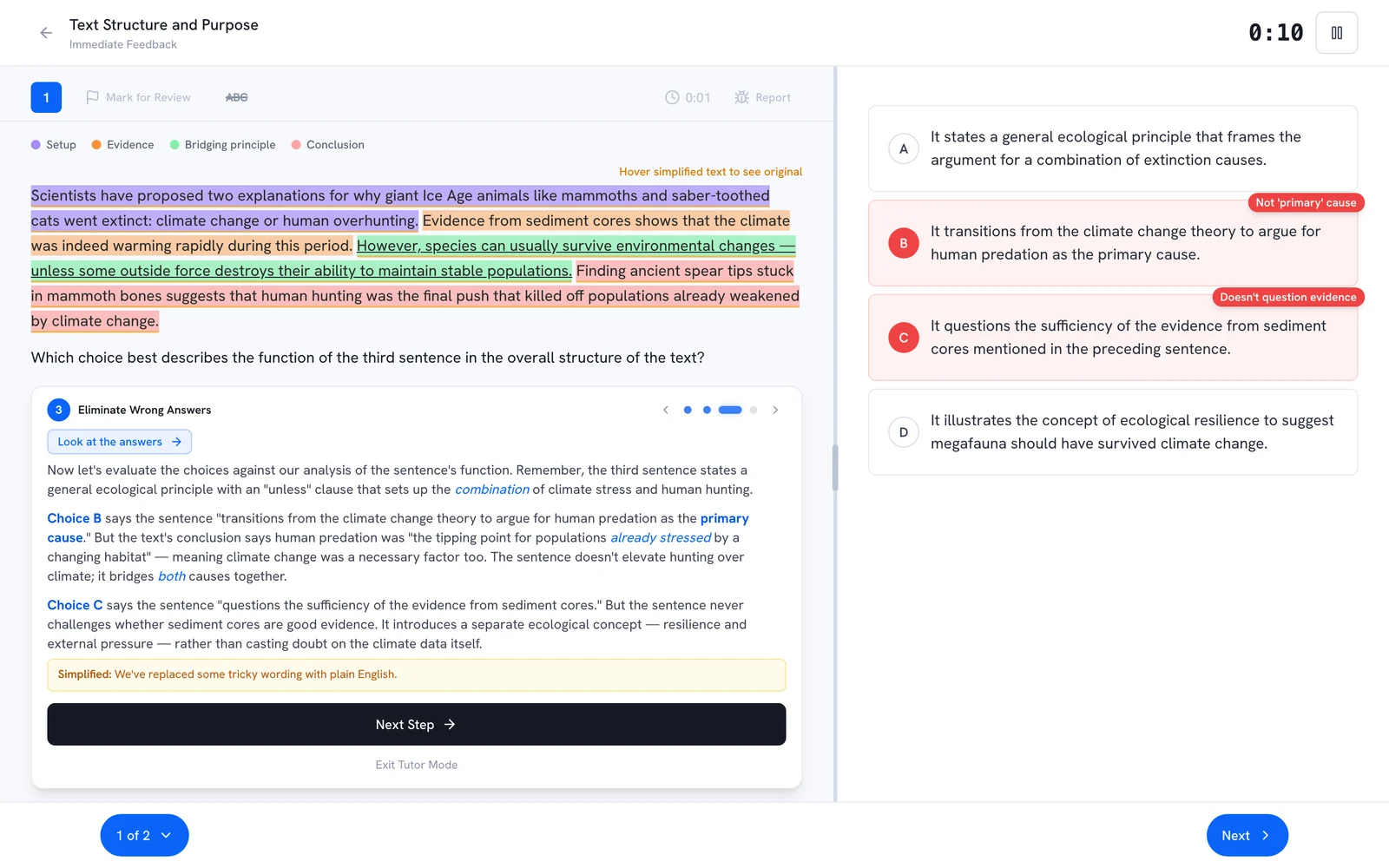
So is an AI SAT tutor just a ChatGPT wrapper?
No. ChatGPT is a general-purpose assistant, useful for a one-off "explain this to me" moment, and free on its lower tiers. A dedicated practice engine keeps a record of every answer you give and uses it to decide what you work on next. They do different jobs.
Using both is reasonable: a chatbot for an occasional "wait, why does this work" tangent mid-practice, and a tracked platform for the practice that adds up over weeks. Just know what you're paying for when you use something purpose-built: a record of your own performance that decides what you practice next.
Want to see your own mastery map?
Practice with free SAT questions that adjust to how you answer.
Start free